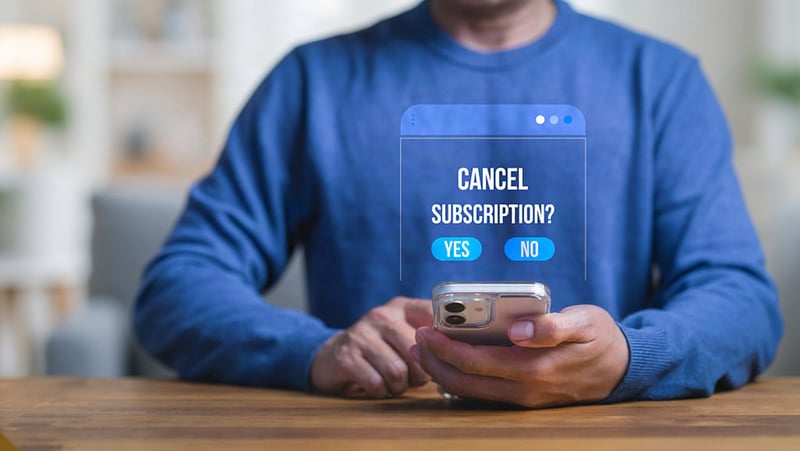

For two decades, annual recurring revenue (ARR) has been one of the most valuable things a business can own. However, some of this revenue only recurs because customers forget to review their subscriptions, cannot easily leave, or haven't gotten around to cancelling.
But passive customers like these will not remain so for long. Consumers increasingly expect flexibility, control, and demonstrable value from their subscriptions. In exclusive new consumer research conducted in partnership with leading payments and billing platform Stripe, we have uncovered the trends in subscriptions and consumer behaviour being driven by AI. The research shows that getting value from a subscription is important to 85.8% of users, and the ability to pause was key for 52.6%. Combined with trends in agentic AI and consumer rights legislation, these findings show that subscription businesses can no longer assume revenue from passive customers will persist.
How AI and consumer rights will impact recurring revenue
For years, cancellation friction has served to protect passive revenue to an extent, however, it is now coming under pressure from two angles.
Consumer rights legislation
Regulators globally are beginning to converge on standards for subscription services and how easy they are to cancel. The EU’s Directive 2023/2673 went into force in June 2026, and in the UK, Andy Burnham's government announced it would bring forward compliance with the Digital Markets, Competition and Consumers Act to January 2027. The specifics may shift, but UK businesses are expected to comply with the following:
-
Clear information upfront: The key terms, including what happens when a trial ends, the ongoing charges and how to cancel, must be shown prominently before a customer signs up.
-
Reminders before payment: A clear notice must be given before a free or discounted trial converts, and again before each renewal.
-
Two 14-day cooling-off periods: One when a customer first signs up, and a second after a trial converts.
-
Straightforward cancellation: An exit at least as easy as sign-up, available online for anyone who joined online, without unnecessary calls or repeated “are you sure?” screens.
This is likely to put further pressure on passive revenue and expose businesses that have relied on customer inertia rather than continually demonstrating the value of staying subscribed.
Agentic Commerce
Consumer behaviour is shifting from “set and forget it” passive subscription to active monitoring, comparison, and movement between services. AI will accelerate this shift by managing subscriptions on customers’ behalf, identifying unused services, comparing alternatives, surfacing price changes and simplifying cancellation or switching. The result will be greater fluidity between providers.
This change to subscriptions is already underway. Apps such as Rocket Money and Emma read customers’ statements, surface recurring charges, and flag potentially unnecessary subscriptions. A newer wave of AI agents may go further, handling cancellations and comparing alternatives on your behalf. What used to take effort and attention should soon be possible with a single click.
Put the two together, and every subscription business that relied substantially on being forgotten is about to become visible and easy to cancel. This creates a new risk for finance leaders: reported recurring revenue may prove less durable than it appears.
How can businesses reduce the risk to their subscription revenue?
Customers originally subscribed because they had a need or saw a benefit, but when they become passive, it signals their needs have changed, or the business has stopped evidencing value.
Organisations should reduce time to value and prioritise building proactive, valuable customer relationships to ensure fewer customers reach the point where they stop engaging altogether.
This means doubling down on the fundamentals. Subscription pricing and features need to continue to reflect customer needs. There should be clear communication about what customers are receiving and paying for, and transparent usage and renewal information.
The choice is rarely binary between keeping the current plan and losing the customer. There is also a third option: changing the relationship in a way that keeps value on both sides. Proactive prompts to amend, downgrade, or change a subscription when customers haven’t engaged for a while will help build customer loyalty. When a customer tries to cancel, a business with only “stay or leave” options will lose the customer and the revenue. In our report with Stripe, 52.4% of respondents said they had encountered a pause or discounted-tier offer that felt relevant enough to stop them cancelling or switching.
A business that offers a relevant pause, smaller plan, or better-fit bundle creates a different outcome: the revenue may change but the customer stays.
What finance leaders should do to mitigate the financial risk
Finance leaders can mitigate the risk of passive revenue leaving the business. Here, we’ve outlined actions that finance teams can take:
Diagnose recurring revenue: Identify how much of your recurring revenue is currently genuinely value-led rather than passive.
Forecast the AI impacts: Model your exposure by examining what your revenue projections are likely to be once low-usage accounts can leave with a single tap or through an agent.
Redesign pathway options: Change the customer relationship with flexible pathways such as targeted pause, downgrade, upgrade, and feature-level options before offering discounts on existing plans.
Think like a regulator: Ensure billing transparency, cancellation design, and complaints data are brought together for a clear view of the value each customer actually receives.
Prepare for AI-driven negotiation: As consumers increasingly use AI to manage their subscriptions, it’s conceivable that an agent could initiate a cancellation or negotiate on a customer’s behalf, potentially triggering a retention offer when the customer has little intention of leaving. Businesses need to understand who or what they are interacting with and develop retention strategies that distinguish genuine customer risk from automated negotiation to avoid rewarding an AI-driven cancellation request with a discount.
This article draws on consumer research which will be released in October 2026. Sign up here to receive it on release and discover how AI is reshaping subscriber behaviour.