
I vividly remember a lively discussion back in March 2025 at Anthropy, the annual event in Cornwall, where leaders gather to explore the future of Britain. We supported a session led by Andy Brown, then Group Chief Sustainability Officer at Anglian Water, that convened a group of businesses, civil society, industry experts, and regulators to talk about the future of the water sector. Sitting in the Eden Project’s tropical rainforest biome, dripping with sweat because I hadn’t accounted for 30-degree heat, we talked about the need to establish an authentic purpose for the water system: one that drives the outcomes we actually need for customers, communities, and nature, rather than the ones the current system happens to produce.
A few months later, the Cunliffe Review landed, acknowledging that the sector needs a fundamental reset. It set out 88 recommendations and called for a new regulator to replace the current fragmented setup. One line stuck with me: “we don't actually know the overall health of the system we all depend on.”
We're now a year on, in the middle of a scorching summer. The rainforest biome is everywhere, minus the humidity. We've just had our fifth heatwave of the season, with temperatures hitting 38 degrees. Climate change isn't coming; it's here, and water is right at the front of it.
There's now plenty of reform on the table. But reform will only take us so far if we don't first understand why the system has struggled to deliver in the first place. Because the uncomfortable truth is that the way the system is set up today makes it very hard to deliver good outcomes for customers, citizens, and nature, whoever is running it.
UK water sector reform is unlikely to succeed through structural change alone. Boards, regulators and government also need a shared purpose that guides governance, investment and accountability across the system. That purpose should align customer outcomes, environmental health and long-term water security.
Why the UK water system is failing
The UK water system is struggling because four problems reinforce one another:
- There is no shared purpose that sets the direction for the whole system.
- Accountability is split across organisations, sectors and regulators.
- Five-year regulatory cycles do not match the decades-long life of water assets and natural systems.
- Poor outcomes reduce trust, which encourages defensive regulation and makes collaboration harder.
The result is a system that can meet individual targets while still failing to deliver the outcomes people, communities and nature need. For senior stakeholders, the practical question is not only how to improve each organisation; it is how to align the decisions that shape the whole system.
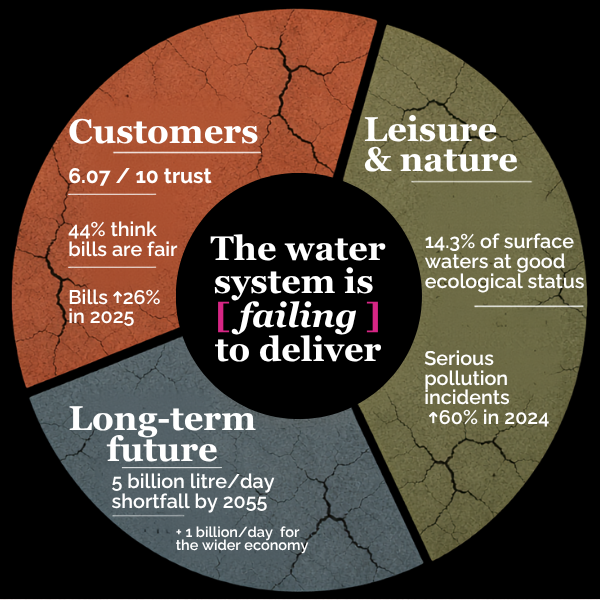
CCW’s Water Matters 2026 report for England and Wales records an average water-company trust score of 6.07 out of 10, with 44% of customers agreeing that their charges were fair. It also notes that the average household water and sewerage bill increased by 26% from April 2025. The Environment Agency reported that 14.3% of England’s surface waters achieved good ecological status in the 2025 assessment, while 75 serious pollution incidents were recorded in 2024, 60% more than in 2023. The Environment Agency also forecasts a five-billion-litre-a-day shortfall in public water supplies by 2055, plus a further one-billion-litre-a-day deficit for the wider economy.
When every part of the system is missing every kind of target at once, the problem isn't the individual companies, regulators, or ministers. It's the system they all work within. The sewage, the bills, the failing companies are symptoms. The reasons the system keeps producing them are harder to see, and they matter more. Below, I will paint a picture of the root causes.
The UK water system lacks a shared purpose
To achieve better long-term outcomes for people and planet, we need to zoom out, take a step back, and ask the question: what are we optimising for? It appears that there is no agreed answer to that question. Direction is set in silos, target by target, with no coherent view of how those targets interact and no basis for weighing the trade-offs between them: the cost to customers, the health of the environment, and the long-term resilience of supply. The Cunliffe Review identified this as a failure of direction rather than a detail, pointing to "failure in Government's strategy and planning for the future" as the first of the deep-rooted, interlocking failures behind the sector's state.
There's a principle in systems thinking worth applying here: the purpose of a system is what it does, not what it says it does. By that test, the water system's purpose over the past decade has been to pay out dividends, keep bills down by deferring investment, and hit the next five-year target, while rivers, assets, and public trust are drawn down. This is what Andy Brown has called the need for a shared "meta-purpose": the idea that sector-wide change cannot be achieved by organisations working in isolation or with antagonistic aims. Each actor (government, regulators, companies, etc.) must contribute to a common purpose they hold together, and then define their own role in service of it. That shared purpose would give every decision a common test: does it create long-term value for customers, communities, the environment and future water security, rather than minimising short-term cost? Without it, when every part optimises for its own narrow goal, you get exactly the results we see.
The most striking evidence of this absence is what the system does not know about itself. As Sir Jon Cunliffe put it when publishing his report, "we simply do not know the overall health of the system", with the last full assessment overseen by Ofwat more than twenty years ago. It is hard to imagine a clearer sign that no one is holding the whole.
Accountability is divided so no one holds the whole
If the first cause is the absence of a shared purpose, the second is the absence of anyone with a view wide enough, or a mandate strong enough, to pursue one. Responsibility for water is split across government and four separate regulators, each holding only a slice of the picture. The Cunliffe Review described the resulting landscape as fragmented and overlapping. The Public Accounts Committee concluded that 'no-one is taking ultimate responsibility for balancing affordability with long-term needs.'
The fragmentation runs wider than the regulated companies. Agriculture is the largest single source of pollution in many catchments, yet it sits almost entirely outside the framework that governs water companies. In several Welsh SAC rivers, farming drives the majority of the phosphorus load while storm overflows account for a small fraction, and yet the regulatory attention and enforcement fall overwhelmingly on the water companies. When responsibility is fragmented, accountability dissolves. Everyone is responsible for a part, and no one is responsible for the result. The enforcement record also shows why accountability matters. The Environment Agency says it concluded 67 prosecutions since 2015, securing fines of more than £153 million, - despite there being more than 11,000 investigations into water companies in that time.
Short-term thinking is misaligned with long-term water resilience
The third cause is a mismatch of time. Rivers, aquifers, and the vast underground network of pipes and treatment works operate over decades and generations. The system that governs them operates in five-year price-review cycles. That mismatch has consequences. It rewards predictable, engineered fixes that fit neatly inside a funding period, over the patient, adaptive, long-horizon work that natural systems and ageing assets actually need. It produces investment in bursts rather than steady care, and it leads to companies underspending on the slow work of maintenance because the incentive is to hit the near-term number.
The financial structure pulls the same way. According to Common Wealth, the sector has paid out an estimated £85 billion in dividends while accumulating around £72 billion of debt from a starting point of zero, since privatisation in 1991. Close to a third of the average bill now services that debt and those dividends rather than the system itself. The incentive is to hit the near-term number, not to invest in the slow work of long-term resilience.
Low trust keeps the water system in a defensive cycle
The fourth cause is the one that makes the others self-sustaining. Poor outcomes erode public trust. What’s more, the sheer complexity of the system: five-year plans and a tangle of regulatory scope mean very few people understand what bills actually pay for, what is or isn't allowed to be invested in, or who decides. A system this hard to see into is a system that is hard to trust.
Lost trust generates political pressure. That pressure produces tougher, more punitive, more compliance-focused regulation, bonus bans, automatic fines, special measures. And a system oriented around compliance and defensiveness has less room for the openness, honesty, and long-term thinking that would actually improve outcomes. So outcomes stay poor, trust falls further, and the loop tightens. You can see two polarised factors operating at once today: the strongest enforcement powers the sector has ever faced, sitting alongside the lowest trust and the steepest bills on record. It’s important to note that these bills are in part a rebound from years in which the political and regulatory focus was on keeping bills low, deferring the investment now being paid for all at once. The tragedy is that this dynamic pushes the system into a defensive crouch at precisely the moment it most needs to be open, collaborative, and willing to take a long view.
Why UK water sector reform alone will not break the pattern
None of this is to dismiss the reform now underway. The Cunliffe Review made 88 recommendations and the government’s 2026 water white paper proposes a new integrated regulator and a longer-term focus for the sector.. These changes matter, but structural reform changes the architecture without necessarily changing the logic that runs inside it. A single regulator can inherit the same fragmented purposes, the same short horizons, and the same defensive culture, simply housed under one roof instead of four. Sir Jon Cunliffe himself was explicit that "there is no simple, single change, no matter how radical, that will deliver the fundamental reset that is needed." The risk is that we rebuild the structures, declare the problem solved, and find ourselves a few years from now asking why so little has changed.
What the water sector needs: Shared purpose and stewardship
Every one of these causes traces back to the same absence. There is no shared answer to what the water system is ultimately for, and no principle that aligns how everyone within it acts. Get the structures right, and you have still not supplied that. What the sector needs is a common purpose strong enough to hold the whole system to account for its outcomes, and a way of acting on it that takes seriously the long horizons, the interdependence, and the shared responsibility the system actually has.
What is water stewardship?
Water stewardship is the responsible care of water as a shared system. In practice, it means making decisions that balance customer needs, environmental health, and long-term water security, while being open about trade-offs and accountable for outcomes. Compliance sets a minimum standard. Stewardship asks whether decisions protect the system and the people who depend on it over time. A great account of what stewardship means in the water sector is outlined by Dr James Jenkins, Head of Sustainability and Natural Assets and Dr Jo Jolly, Director for Natural Assets, Environment and Innovation at Ofwat. Stewardship is not a softer alternative to regulation. It is a way to connect regulation, governance, capital allocation, and operational choices to the outcomes the system exists to deliver while acting with care, integrity, and foresight.
Our research, Purpose by Design: Ownership, Governance, and the Future of Business, explores how purpose can be protected through the structures that shape decisions. While it looks across sectors, its central questions are highly relevant to water: who is accountable for long-term outcomes, how are trade-offs made, and what prevents stewardship from being lost when pressures change?
If you’re exploring how to turn purpose into action, our Purpose and impact consulting services can help you define, embed and activate purpose across your culture, systems, governance and processes, creating tangible, measurable outcomes.
Acknowledgement
With thanks to Andy Brown, whose thinking on aligned purpose in the water sector has helped to shape the argument here, and who generously reviewed an earlier draft.