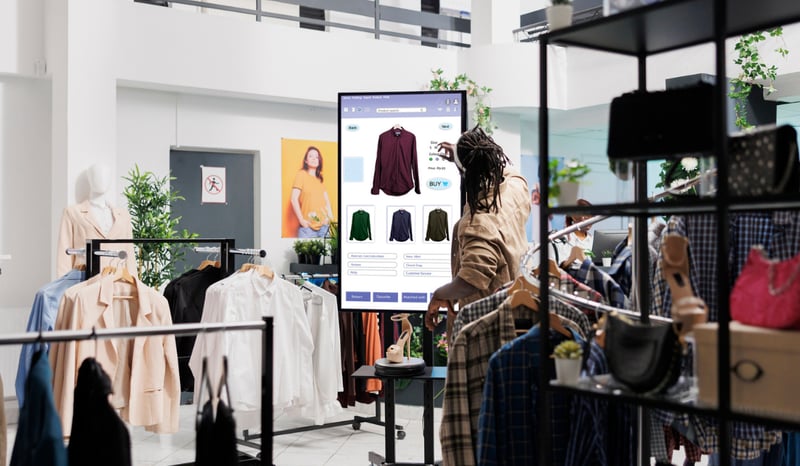

For some retailers, the store has quietly become the missing link in an otherwise sophisticated customer journey. Online, customers see hyper-personalised ads, curated edits and AI-powered experiences that seem to know exactly what they need. But the moment they cross the threshold into a physical store, that intelligence often disappears, and with it, conversion, loyalty and valuable data.
This is where the phygital retail experience comes in: using AI to join up online and in-store so customers feel like they are on one continuous journey, not starting again at the door. When retailers use AI to connect customer data, journeys and store operations, the shop floor stops being a digital dead zone and becomes a powerful extension of their digital experience, driving higher spend, better service and a more resilient business.
In a world where data is your greatest asset and margin pressure is relentless, that bridge between channels is no longer a nice-to-have. It is a commercial imperative.
The expectation gap in the phygital retail experience
A shopper sees a hyper-personalised ad on social media - AI-targeted, right product, right moment, right channel. They move to your app, where an AI stylist makes recommendations that feel like they actually know them. The digital experience is first class, and it is working: they are motivated to come in store and interact with your brand.
Then they walk through the door.
The store associate has no idea what is on their wishlist. The fitting rooms are cramped and poorly lit. The seamless, personalised journey they were on comes to an abrupt halt. That excitement evaporates, and so, often, does the sale.
This is the expectation gap - the distance between what your customer has been led to expect from your digital experience and what they actually receive in store. It is one of the most damaging and underestimated problems in retail today.
Your store should be your greatest brand asset. Done well, it is the place where a customer stops browsing and starts engaging in your brand, your product, and the lifestyle you represent. It drives repeat visits, fuels advocacy, and builds the kind of loyalty that no algorithm can manufacture. In an attention-deficit world, that physical connection matters more than ever. The problem is that too many retailers are letting it down by failing to carry the digital experience through the door with them.
Scaling AI for a truly phygital retail experience
You cannot talk about building a phygital retail experience in 2026 without talking about AI. AI is now reshaping every stage of how customers discover, engage with, and buy from a brand. The retailers who are winning are embedding AI across the entire customer journey and using it to piece together fragmented data sets, e.g., linking in-store customer tracking with in-store purchases, behaviour, and conversion/drop-off.
At a high level, consider what this looks like across three stages:
-
Discover: Is your brand optimised to appear in AI-powered searches? Are you leveraging buying patterns, time-of-day signals, and preferred channels to sharpen your paid media? Can customers purchase directly from your social content? Chanel’s Try On service is an excellent example. This virtual online experience encourages customers to view products online, which then drives footfall to the physical stores. Simultaneously, Chanel gains valuable insights into customer demographics and product demand, informing crucial downstream decisions regarding stock levels and design.
-
Engage: Are you offering AI-enhanced styling and product recommendations on your app and website? Are you using AI in your stores to enhance customer experience, such as showcasing AI-powered mirrors in your fitting rooms? Can you link a customer's digital basket to an in-store shopping service in real time? Imagine a retail experience where you can up-sell / cross-sell items at the point of sale based on showing that a certain demographic of shoppers tends to make these purchases together. Picture a retail environment where data, revealing that certain shopper demographics frequently purchase specific items together, allows for targeted up-selling and cross-selling right at the point of sale.
-
Buy: Can customers complete a purchase through social platforms without leaving the app? Do you have a clear view of what triggers a purchase decision, online and in-store, and are you using that to influence the experience? Let’s take the Uniqlo app as an example, which provides dual benefits: it enhances the customer experience by displaying their purchase history across both physical retail and online channels, and simultaneously offers Uniqlo a valuable opportunity to analyse customer buying patterns and motivations.
The challenge is that most retailers still treat their digital customers and their in-store customers as separate personas, when the reality is that today's shopper moves fluidly between both. We all do it.
More critically, research suggests that 75% of AI initiatives fail to scale. The reason is almost always the same: technical debt.
Legacy POS systems, outdated ERP platforms and infrastructure that was never built for real-time AI become constraints that prevent brilliant digital initiatives from ever reaching the shop floor. It is the equivalent of putting a Ferrari engine on a horse and cart. The engine is impressive, but the foundation cannot carry it.
That is not just a technology problem; it is a strategic one. It limits your ability to respond to shifting consumer trends, supply chain disruption, and the geopolitical volatility that is now a permanent feature of the retail landscape.
The pragmatic path forward for a phygital retail experience
Here is the honest truth: most retailers cannot wait for a three-year, multi-million-pound rip-and-replace programme before realising value from AI in their phygital retail experience. A clean-slate technology overhaul is rarely feasible, and in a market moving this fast, it is rarely wise either.
At Clarasys, we recommend a dual-track transformation approach, running foundational technology improvement and front-line innovation in parallel, rather than sequencing one after the other. The goal is to move from archaic to agentic through targeted, high-ROI wins that generate momentum and fund the broader transformation.
In practice, this means:
- Identifying your “crux” problems
Focus on the specific pain points that are blocking your ability to deliver a joined-up experience. For example, real-time inventory visibility, fragmented customer profiles or limited store‑associate tooling. - Building AI-native solutions around your existing infrastructure
Instead of waiting to replace core systems, use AII‑enabled services to present a unified view of stock, customers and operations at the edge. Surface the insight your teams need without forcing every change through a slow, risky core‑system overhaul. - Using AI to improve your data, not waiting for perfect data
Use AI to help cleanse, standardise and enrich your highest-value data sets - starting with the customer and product data that underpin your phygital use cases, rather than treating data quality as a precondition for progress. - Focusing on the moments that matter along the customer journey Some interventions will be highly visible and front-end, others will be unglamorous and back-end, all of them pointing in the direction of your north star.
Consider what a "good enough" phygital experience looks like in practice. A store associate scans a customer's app barcode at the door. Instantly, they can see their wishlist, their recent purchases, and contextual signals - this customer is shopping for a girls' weekend away, or a family hiking trip. That single insight transforms the conversation from transactional to consultative. It feels natural to the customer, and genuinely helpful, not intrusive.
That is the kind of in-store experience customers talk about and return for.
The AI store associate - a human-AI retail teammate
Now, let us take that scenario further, because technology is only part of the answer. One of the biggest opportunities in creating a phygital retail experience is how you design the relationship between AI and your people.
At Clarasys, one of our core beliefs is that your employees are your greatest asset. The purpose of a phygitally enhanced store is not to replace the store associate with AI. It is to remove the friction and admin that is currently preventing them from doing their jobs brilliantly.
A great example can be seen at M&S, where they are providing colleagues with access and training to Microsoft Co-Pilot:
“Now 11,000 colleagues will have AI support at their fingertips, pulling together summaries from multiple sources and giving them the data, analytics and insights they need in seconds.”
M&S CEO Stuart Machin
But this raises questions that go beyond tooling:
- How do you train and orchestrate your people to work alongside AI in a way that feels natural, not surveillance-like?
- How do you make this feel like an upgrade for your employees, not a threat?
Here is where I see a genuine opportunity that many retailers are missing:
-
Invest in digital and human skills, together
Use AI rollouts as a moment to upskill your people - not just in digital literacy, but in the softer skills of selling, styling and service. Position AI as their co‑pilot, not their competitor. - Design feedback loops from the shop floor to digital teams
Observe how associates perform when they have better information. Gather their feedback on what is working and what is not. They are your eyes and ears on the shop floor. They understand how customers actually want to be approached, what their barriers to purchase are, and what they ask for that you do not currently stock. Capture this insight and feed it back into product, merchandising and digital experience teams.
Your employees are not just the deliverers of the customer experience. They are a primary source of customer insight. In a phygital world, their role as human–AI teammates becomes central to your differentiation.
Organisational alignment before investing in phygital retail AI
Bringing this all together requires something that many retailers struggle with more than technology: internal alignment.
Building a phygital experience demands that commercial, technology, operations, and store teams move in the same direction, at the same time. In most traditional retail organisations, these functions are siloed, with limited visibility of each other's constraints, priorities, and pain points. Yet they are all, ultimately, trying to solve the same problem: how to best serve the customer.
Breaking those silos is where the real transformation work begins.
At Clarasys, our Double Diamond workshop approach is designed to do exactly that, bringing disparate teams together, creating a shared understanding of the problem, and building consensus around recommendations that everyone can actually execute. We do not produce business cases that gather dust. We move directly into action, targeting the highest-priority interventions and generating immediate value while keeping the bigger picture in view.
The pace of change in consumer behaviour is not slowing down. Retailers who cannot galvanise quickly around new problem statements, who remain trapped in internal fragmentation while their customers' expectations continue to rise, will lose ground to competitors who can. The phygital store is not a future ambition. It is a present-day imperative.
The question is whether your organisation is structured to build it.
If you are ready to break down the silos and design a future where your physical store is a powerful extension of your digital brand, get in touch today. Alternatively, learn more about our AI-consulting services here.