
.png?width=200&height=200&name=Untitled%20design%20(4).png)
A purpose-aligned value proposition delivers superior customer outcomes and measurable, material impact for people and the planet, not as a side effect but by design. It connects the customer’s goals (what they need to achieve) to a small set of credible impact metrics and makes the two move together. Done well, the impact becomes counted, not claimed.
To build a purpose-aligned value proposition, connect the customer’s goals or ‘jobs to be done’ (the work they need to accomplish) to a focused set of key environmental/social results, engineer the offer so customer and impact outcomes reinforce each other, and set up ways to measure and check progress from day one. When you do this well, you gain win rate, price realisation, new revenue routes, and reduced risk, alongside real impact for people and the planet.
What is a purpose‑aligned value proposition?
A purpose-aligned value proposition explicitly links what your customer is trying to achieve (their goals or jobs to be done) with a small, defensible set of environmental/social results (for example, CO₂e intensity, waste avoidance, water use, or labour standards). The product, pricing, data, and delivery model are built so that when the customer achieves their outcome, such as faster onboarding, lower operating cost, or better reliability, the real-world outcome improves at the same time. It works by default, not by accident.
It is not a manifesto. It is a design and measurement discipline that makes your impact clear in the boardroom and credible in RFPs, using evidence that is good enough to make decisions now, and refined over time, with a route to independent assurance as the data matures.
How a general value proposition differs from a purpose-aligned value proposition
|
General value proposition |
Purpose‑aligned value proposition |
|
|
When you design a value proposition that is truly aligned with your purpose, the commercial outcome is that customers select it because its impact is genuine and trusted, rather than just for show.
Organisations that align customer outcomes with measurable impact typically see higher win rates, stronger price realisation, lower cost to serve, and reduced risk as expectations converge.¹
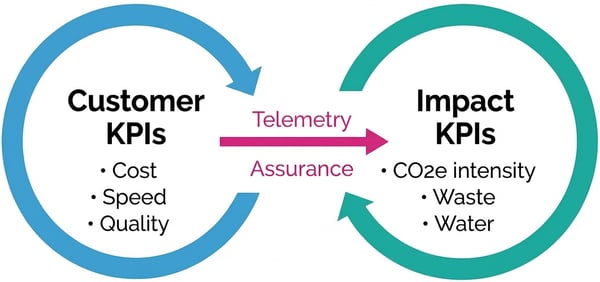
Figure 1 - The Purpose Reinforcement Model
How to build a purpose‑aligned value proposition
A purpose-aligned value proposition isn’t a slogan; it’s a design discipline. Here’s how to build one in practice.
Figure 2 - Five steps to a purpose-aligned value proposition
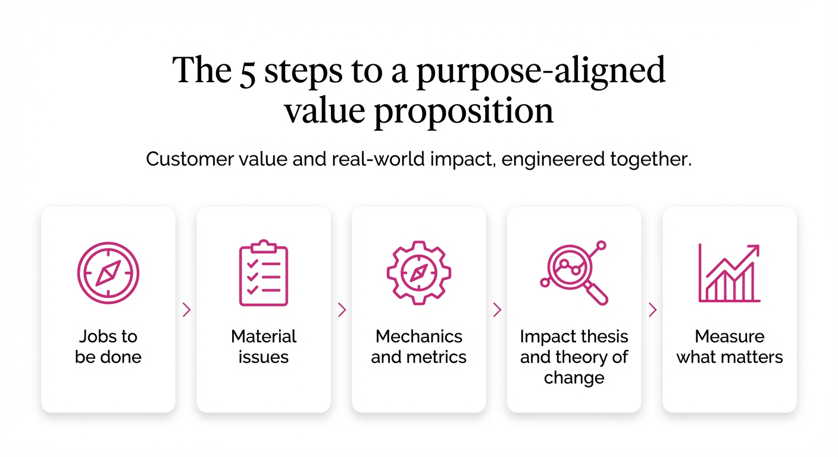
1) Start with the customer’s jobs-to-be-done
Map the customer’s functional, emotional, and social goals, for example, reducing total landed cost, de-risking supply, signalling trust, or reducing time to value.
Identify key parts in the customer journey where your offer makes the biggest difference (the “moments of truth”), such as onboarding, service recovery, handovers, or performance guarantees. Link those critical moments to the key metrics that they actually care about and use to measure success, such as delivery speed, reliability, customer happiness, or cost per unit.
Create measurable hypotheses that combine customer value and impact. Instead of broad statements such as “optimise sourcing sustainably,” use specific targets like: “Reduce procurement cycle time by 20% and cut Scope 3 emissions intensity by 10% within 12 months.”
A real example: E.ON Heat-as-a-Service²
E.ON piloted a Heat-as-a-Service model where households paid for “warm hours” rather than the volume of gas consumed. The offer focused on delivering the customer’s goal, consistent warmth at a predictable cost, while improving real-world outcomes.
Customer KPI: 30 per cent reduction in heating cost volatility
Impact KPI: 15–20 per cent reduction in CO₂e, driven by more efficient heat management and reduced energy demand
How it works: By shifting from units of fuel to a guaranteed comfort outcome, customers used less energy for the same experience, which lowered bills and emissions at the same time. This created a purpose-aligned reinforcement loop: better efficiency improved customer savings, and improved savings reinforced lower carbon intensity.
Why it matters: It shows how a value proposition designed around customer goals and measurable impact can deliver higher value at lower risk, without relying on claims, messaging, or moral appeal.
Figure 3 - Purpose-aligned value loop in heat-as-a-service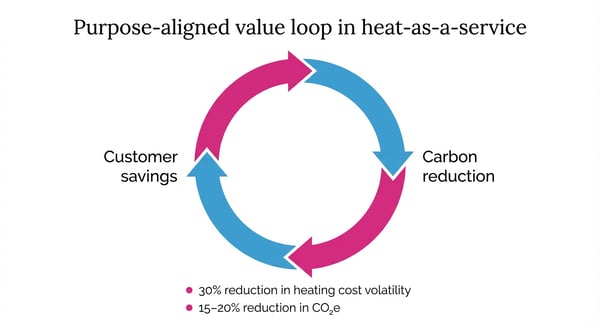
2) Choose your key impact priorities
Don’t try to track everything (avoid ESG shopping lists). Instead, select only the two to four key impact areas your offer can influence meaningfully, for example, lowering energy/water use, reducing waste, or improving labour conditions and clearly define what you will measure and what you won’t. Finally, use “double-check” materiality to consider what affects enterprise value and what affects people and planet.
3) Design the value proposition mechanics so success produces impact by default
This step is about designing your product or service so that helping your customers succeed also creates positive impact for people or the planet. Build your “Purpose Reinforcement Model” - design your product or service so that your customer KPIs (like faster uptime or higher yield) are directly linked to your impact KPIs (like reduced carbon footprint or less waste). When one improves, the other must improve at the same time.
Use automatic product-embedded data collection and a clear, standard measurement plan that defines the baseline, method, and how often you will check results.
Charge based on results, not just your good intentions.
Price to outcomes, not virtue.
Offer an assured price reduction for results that are verified by an independent third party, for example: “A lower price tier is triggered when CO₂e reductions are independently validated by an accredited auditor.”
Create a clear plan to verify your impact claims, moving from internal controls to a trusted third-party audit over time.
Be honest about any necessary trade-offs, such as a lower margin for wider access or speed versus safety. Govern these decisions with a diverse team from product, commercial, sustainability, finance, and legal.
4) Write the impact thesis and a compact theory of change
Clearly set out the problem you are solving, the beneficiaries, and the limits of your project (scope and boundaries). Draft a simple theory of change to show how your efforts lead to impact:
- Inputs: The resources you put in
- Activities: The actions you take
- Outputs: The immediate results or deliverables
- Outcomes: The short and medium-term changes for your customer and beneficiaries
- Impacts: The long-term, real-world good.
Identify any assumptions you are making and any potential unintended consequences, such as rebound effects, so the logic is transparent and auditable.
Figure 4 - Theory of change
.svg)
5) Focus on clear, reliable metrics
Select a small, credible set of commercial, customer, and impact metrics. Track them consistently and work to strengthen data quality over time. Be fully transparent about measurement methods, baselines, and boundaries so customers and auditors can trust the results.
Conclusion
A purpose-aligned value proposition doesn’t rely on claims, positioning, or aspiration. It is a practical way to engineer customer value and real-world impact so they reinforce each other by design. By connecting customer goals to measurable outcomes for people and the planet, and building the mechanics, data, and assurance to back it, organisations create offers that win on performance and on purpose. The result is value that is credible, scalable, and built to last.
For more resources to help you translate mission into measurable impact, view our purpose-driven performance collection.
If you’re ready to move beyond claims and start engineering purpose‑aligned value propositions, we can help. Our consultants work with organizations to connect customer goals with measurable outcomes for people and the planet, building the mechanics, data and assurance you need to make impact and commercial performance reinforce each other by design.
Find out more about our purpose and impact consulting services | Talk to us about how we can help you design, test and scale a purpose‑aligned value proposition for your organization.
References
1. Friede, G., Busch, T., & Bassen, A. (2015). ESG and financial performance: Aggregated evidence from more than 2000 empirical studies. Journal of Sustainable Finance & Investment.
Eccles, R.G., Ioannou, I., & Serafeim, G. (2014). The Impact of Corporate Sustainability on Organizational Processes and Performance. Harvard Business School Working Paper
McKinsey & NielsenIQ (2022). Consumers care about sustainability — and back it up with their wallets.
Carlsson, F., & Johansson-Stenman, O. (2012). Willingness to pay for sustainable goods: A meta-analysis. Environmental and Resource Economics
2. E.ON UK, Heatio Ltd., & Energy Systems Catapult. (2024). Energy-as-a-Service: Pilot Phase Evidence Report. Department for Energy Security and Net Zero.