
Marketing and sales teams play a critical role in making circular business models commercially viable. This article explains how organizations can redesign incentives, customer journeys and go-to-market capabilities to scale circular growth across sectors, not just fashion.
The future of market-leading brands will not be built on unidirectional sales and simple, one-off transactions. Instead, long-term profitable growth belongs to organizations that manage value across lifetime customer relationships, intelligent asset recovery, and radical resource efficiency.
This is the commercial promise of the circular economy.
However, translating this vision into a go-to-market reality falls heavily on the shoulders of marketing and sales leaders. Too often, circularity has been confined to an isolated conversation for the sustainability team. When pushed into the market as a purely compliance-driven or "green" initiative, it hits immediate resistance. Frontline teams view it as extra work, sales forces ignore it, and customers stick to what is familiar.
To win, a circular economy business model cannot just be a sustainable alternative. It must deliver a superior, friction-free customer experience that makes the linear option feel completely obsolete.
Why circular offers fail to convert despite consumer demand
Every commercial leader is familiar with the behavioral disconnect in modern retail: consumers overwhelmingly state they want sustainable options, but their actual purchasing behavior lags behind. Bridging this "intent vs action" gap is the single biggest challenge in circular marketing.
The data proves the consumer appetite is expanding exponentially. According to the ThredUp 2026 Resale Report, the global secondhand apparel market is projected to reach $393 Billion by 2030, more than 2X faster than the overall apparel market. Mainstream shoppers are ready to participate, but only if the experience matches the convenience of the traditional alternative
Consider how market leaders have restructured their operations to normalize these behaviors:
- Selfridges launched its "Reselfridges" initiative, positioning curated luxury resale, fashion rental, and repair concierges directly on the main shopping floor and prime digital channels. By treating circularity as a co-equal premium experience rather than a hidden, down-market afterthought, they unlocked major brand preference.
- Decathlon generated €420 million in circular turnover in a single year by making their "Second Life" and rental offers highly visible and extraordinarily easy to navigate within their large-format stores.
Neither brand succeeded through clever messaging alone. They succeeded by executing a profound commercial strategy transformation that explicitly aligned internal capabilities with external customer value.
What capabilities are needed for a circular go-to-market strategy?
You cannot successfully scale a circular offer if your commercial engine is running on linear incentives. If your sales force is compensated strictly on product volume, a subscription or buy-back model will fail every single time.
Positioning for a true circular advantage requires a fundamental evolution of your team’s internal skills:
|
From traditional linear skill |
To new circular capability |
|
Transactional unit selling |
Long-term relationship management |
|
Product-feature marketing |
Reverse logistics & value-loop marketing |
|
Pushing consumption & "newness" |
System participation & durability storytelling |
|
Volume-based commission |
Recurring revenue & asset return bonuses |








Strategic change management is not about convincing people to adopt a centrally designed, rigid solution after the fact. It is a design capability. It means sourcing the lived realities of your local retail teams, your reverse-logistics partners, and your enablers to design a balanced value exchange engine from day one.
The practitioner insight: Your sales compensation plan is your most powerful marketing tool. If you don't design a clear, commercial "What's In It For Me?" for your entire value chain, the loop will break.
How can organizations build circular growth capabilities
Transitioning from selling products to managing end-to-end value requires an entirely new set of commercial instruments.
The Circular Advantage Toolkit gives marketing and sales teams a practical way to move from circular ambition to commercial execution. Developed by Clarasys in collaboration with the University of Exeter, it is designed for commercial leaders who need to identify the right circular opportunity, shape an offer customers will actively choose, align their go-to-market model, and build the case for investment and scale.
For organizations trying to make circularity commercially viable, the toolkit strips away academic theory and provides concrete, practical templates. It helps marketing and sales executives turn circular principles into practical action to build a profitable customer relationship today.
Here's a sneak peek of one of the templates from inside the 45-page toolkit:
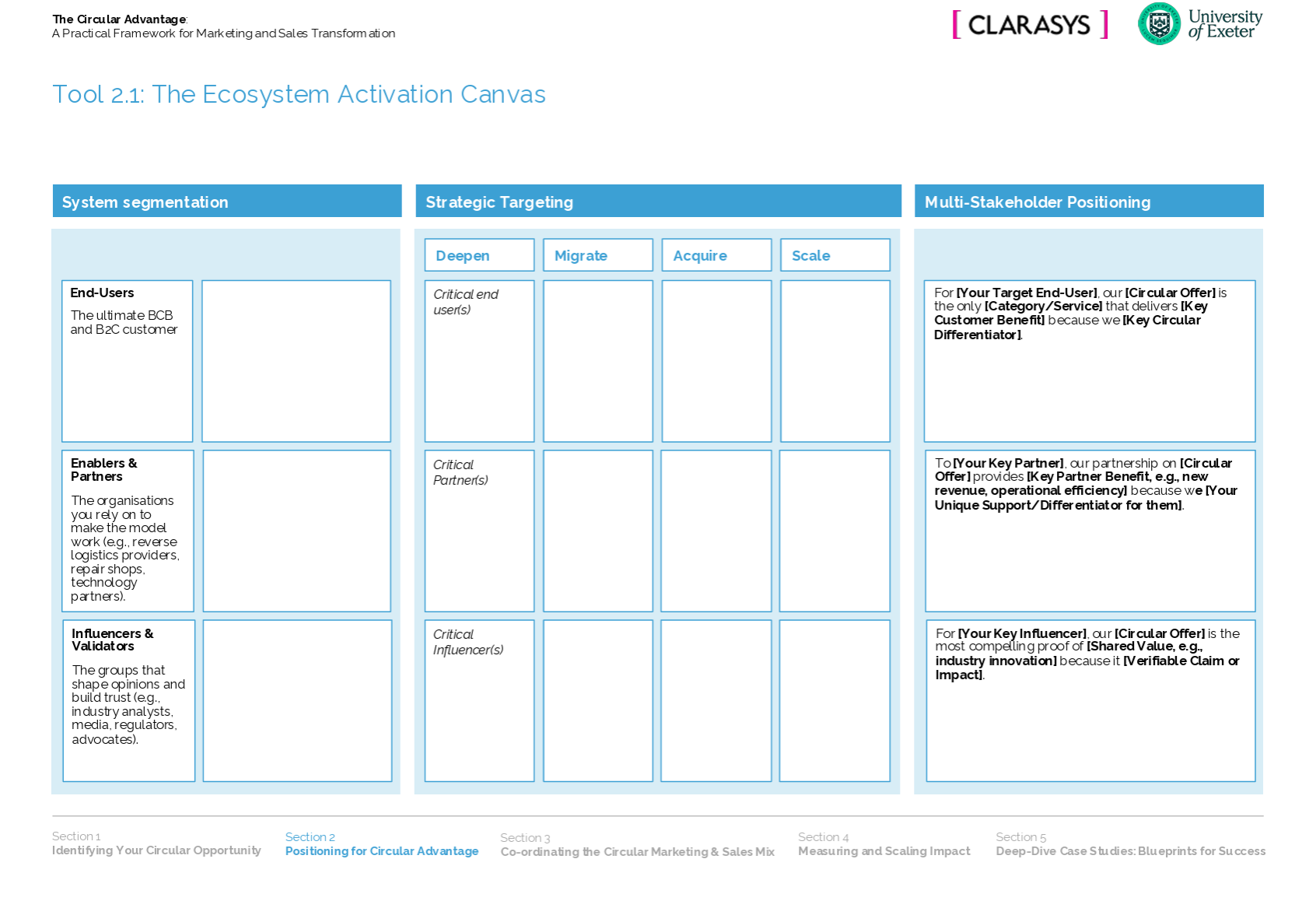
Using Tool 2.1: The Ecosystem Activation Canvas, your team will move past narrow customer segmentations and map out a holistic activation strategy for every critical stakeholder your model depends on.
The shift away from purely linear transactions isn't just about compliance, it's a massive commercial opportunity. Stop managing circularity as a downstream constraint and start using it to build a resilient, multi-layered growth engine.