

Organizations are investing heavily in designing circular value propositions, from hardware subscription models to furniture trade-in programs and luxury garment refurbishment. Yet, behind the scenes, a quiet crisis is unfolding within the commercial tech stack. Despite increasing board alignment and growing customer demand, circular business models routinely fail to deliver their projected financial outcomes.
The breakdown isn't happening in the supply chain, nor is it driven by consumer apathy. It is happening because companies are attempting to manage multi-directional, lifetime customer relationships using rigid, one-way linear marketing and sales software.
By commercial tech stack, we mean the connected systems that support marketing, sales, service, fulfillment, returns and product data across the customer journey. In a circular model, that cannot stop at the first sale. The same customer may rent, return, repair, resell, upgrade, or trade in the same product over time, so commercial teams need one connected view of the relationship.
The commercial case for fixing this is growing fast. Independent industrial studies estimate that the global market for Digital Product Passport (DPP) Technology will grow from $275.1 million in 2025 to a massive $2.99 billion by 2033, with software accounting for more than 69% of the market. This points to an urgent enterprise demand for centralized cloud platforms capable of collecting, structuring, and updating product-level data in real time. This rapid capitalization proves that leading organizations are no longer treating circular transparency as a passive compliance checkbox. Instead, they are aggressively re-engineering their tech stacks to capture and automate resource loops, establishing a domestic inventory buffer and shielding their margins from volatile raw material price shocks.
Why your tech stack breaks circular customer journeys
The root cause of this operational gridlock is data fragmentation. In a standard linear enterprise, the CRM, the ERP, and the marketing automation platform are optimized for a single, terminal event: the initial transaction. Once the unit is sold, the system closes the book.
Circular commerce does not end at checkout. Products move through return, repair, refurbishment, resale and recovery, and each stage affects margin, service cost and customer value. If those events sit in separate systems, teams cannot spot the next best action or support the customer without friction.
When a brand introduces a circular loop such as a buy-back scheme or a repair registry, the traditional tech stack treats the returning asset as an anomaly. Because the customer's purchase history isn't dynamically linked to reverse-logistics or secondary-market values, commercial teams remain entirely blind to the user's current asset status.
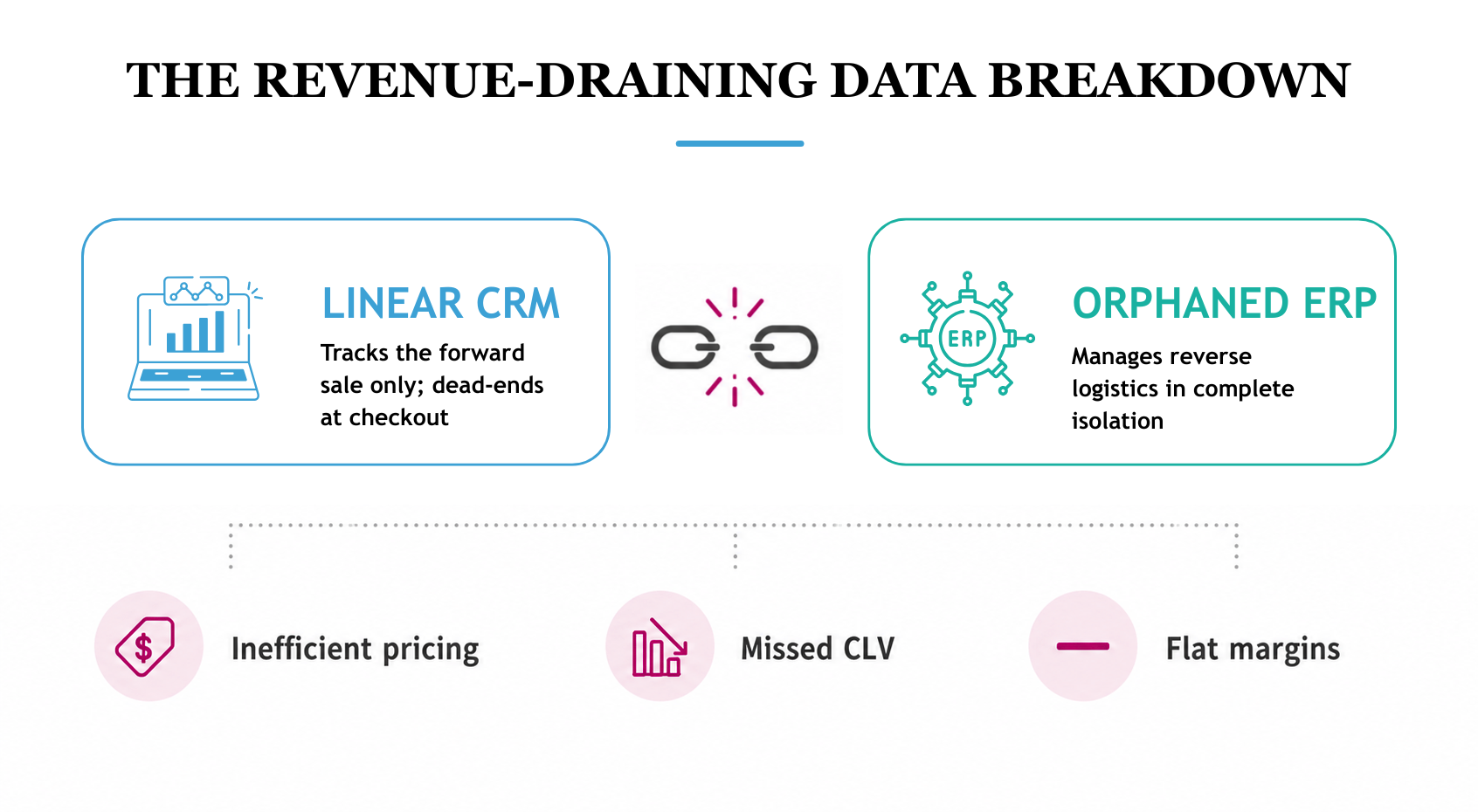
Without a unified data foundation, brands suffer from severe operational friction across the customer journey:
- The blind acquisition trap: Marketing teams continue to spend heavily on traditional customer acquisition channels, completely unaware that a significant portion of consumers would convert faster if an automated, upfront trade-in credit was built natively into their browsing experience.
- The fragmented lifecycle: Customer support, physical retail storefronts, and online portals operate on completely disconnected databases. This turns what should be a friction-free return or repair process into an administrative chore that actively damages customer satisfaction.
At minimum, a circular commercial stack needs CRM, ERP, e-commerce, customer service, returns, repair workflows and product-level records such as serial numbers or passport data to work together. If that information is split across teams, pricing, service and remarketing decisions slow down or fail.
What a circular commercial data stack looks like
To unlock true commercial scale, well-known brands across the UK market are learning that they must treat product lifecycles and customer transaction records as a continuous, unified data pool.
A circular commercial data stack does not mean replacing every platform. It means connecting customer, product, condition, ownership, service history and next-step data so sales, service and operations teams can act on the same view.
One useful building block is a digital product passport: a digital record that stores information such as origin, composition, care instructions, repair options and end-of-life routes. For brands, it creates a shared source of truth. For customers, it makes repair, resale and trade-in easier to trust and use.
- Zara has centralized its UK circular strategy through its Zara Pre-Owned platform, integrating repair tracking, customer-to-customer resale data, and digital donation flows to keep garments inside a high-visibility lifecycle.
- Marks & Spencer launched its Another Life platform, integrating an online resale hub with eBay and Reskinned that allows customers to trade in used clothing, shoes, and accessories in exchange for shopping vouchers, instantly turning pre-loved goods into a mechanism for repeat foot traffic and brand preference.
- SharkNinja handles its consumer-facing warranty and refurbishment cycles by syncing its digital customer service channels directly with active serialized product registries. When a user registers, or claims support on a vacuum or kitchen appliance, real-time tracking data updates the centralized system, allowing their commercial teams to orchestrate precise component repair loops and target existing owners with personalized, high-yield trade-in upgrade workflows.
- Cisco runs its global Takeback and Reuse Program via a dedicated cloud portal that interfaces with customer network infrastructure. The system completely automates the collection request, links returning hardware serialization back to the original client account records, and runs automated assessments to determine whether routers and switches should be channeled into their certified remanufactured resale inventory or responsible component harvesting tracks.
The urgency of this technology shift is underscored by a profound generational alignment among tech-native buyers. Multi-sector consumer data compiled by Certilogo highlights that 54% of Gen Z shoppers are already actively familiar with digital passports tracking, driving a market where product transparency directly dictates purchase behavior. Rather than viewing transactions as terminal dead-ends, next-gen consumers expect detailed lifecycle metrics at their fingertips, with 45% looking for continuous care instructions and 44% requiring verifiable product composition data directly on their smartphones. When commercial software integrates these data pipelines seamlessly into the checkout journey, organizations erase consumer skepticism, lower customer acquisition costs, and transition successfully away from fragile linear models toward an enduring, highly resilient circle of value creation.
How CMOs and CCOs can redesign the stack for circular growth
The takeaway for CMOs and CCOs is clear: a circular business model cannot scale if it is treated as an isolated, siloed marketing experiment. Achieving genuine commercial growth requires a deep, fundamental transformation of your customer data architecture and sales incentives.
Start with three questions:
- Where does customer and product data stop after the first sale?
- Which teams cannot see ownership, condition or service history today?
- Which incentives still reward one-off volume over lifetime value and return quality?
These answers will show whether your problem is a tooling gap, a process gap, or an incentive gap.
When you seamlessly connect your customer profiles to your product recovery pipelines, circularity stops being an operational bottleneck and becomes a highly predictable growth engine. For leadership teams seeking practical, field-tested guidance to audit their current commercial capabilities, map multi-directional user journeys, and construct a bulletproof business case for the boardroom, structured support is available.
If you are assessing where your current tech stack is blocking circular growth, the Circular Advantage Toolkit offers a practical place to start. It helps marketing and sales teams map circular user journeys, spot gaps in data and incentives, and build a stronger case for change.
Explore the Circular Advantage Toolkit, developed in collaboration with the Exeter Centre for the Circular Economy, to map your circular journey and plan the next changes to your commercial tech stack.