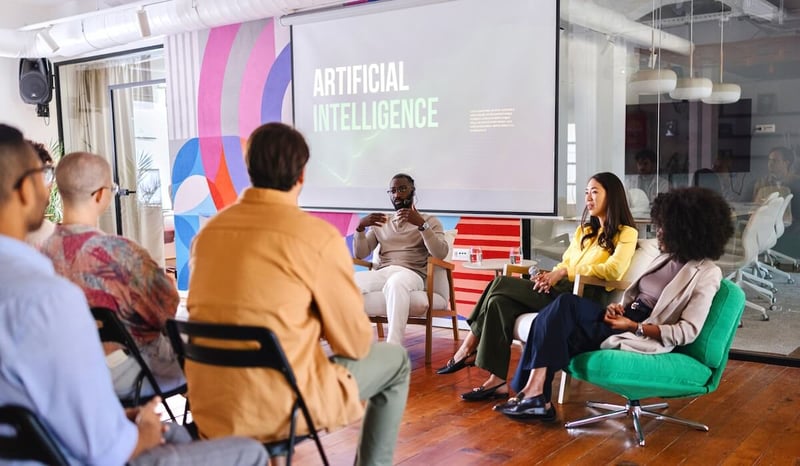

This article draws insights from a Clarasys AI and the Future of Product Management panel event hosted by Ivie Alonge and Michael Watson, with contributions from Lindsay Cameron, Honor Hyde, Ellen Brownings, Alex Phipps. The discussion focused on four practical themes: how client expectations are changing with AI adoption, which mindset shifts Product Managers (PMs) need to make, how the role may evolve over the next five years, and which tools can help Product Managers work better today.
Those themes reflect what many organizations are now facing in practice. At Clarasys, we work as Product Managers on client engagements and alongside client-side Product Managers to help organizations strengthen product capability, ways of working and operating models. From that perspective, the more useful question is not whether AI will replace Product Managers. It is what Product Managers, product teams and leaders need to do differently as execution gets faster and expectations rise.
AI is changing product management, but the biggest shift is not that Product Managers are becoming less useful. It is that delivery is speeding up, clients want clearer evidence of value and routine work is becoming easier to draft, map and analyse.
That moves PM value further towards context, judgement, trust, systems thinking and the ability to design better ways of working at scale. This is where context engineering matters: setting clear goals, framing the problem well, giving AI the right information, understanding system impacts and deciding where human review still needs to happen.
For a broader view of how AI is changing the Product Manager role, read our guide to the role of the Product Manager in the age of AI.
Why AI is raising expectations faster than operating models can keep up
AI is raising the baseline for speed, clarity and evidence. Product teams are under pressure to move faster, explain value more clearly and show how work is changing as AI becomes part of delivery.
For Product Managers, the challenge is not just adopting a tool. It is making sure the operating model can support faster learning, clearer decisions and more visible accountability. That is often where organizations feel the strain first. Expectations move quickly, but workflows, governance and team habits do not always move with them.
Across client organizations, expectations are beginning to shift in four clear ways:
- More scope and depth from the same teams.
- Faster analysis and clearer evidence of ROI.
- Greater transparency about where productivity gains come from.
- Product Managers and delivery teams who can role model effective AI use in practice.
In the public sector, the picture is more uneven. There are strong pockets of innovation, but data access, infrastructure, organizational silos and limited knowledge sharing make it difficult to scale what works.
AI adoption is not just a tooling challenge. It is an operating model challenge. Organizations may have access to powerful models, but still struggle to share data, redesign workflows or move successful experiments beyond individual teams.
That matters for Product Managers because stronger AI capability does not automatically lead to better product decisions. The real opportunity is to help teams use AI in ways that improve learning, prioritization and delivery without losing trust, clarity or control.
This is where product capability becomes a competitive issue. Organizations that benefit most from AI are not simply the ones with access to tools. They are the ones that can connect product strategy, delivery workflows and decision-making more effectively.
Action for PMs
Move beyond asking, “Which AI tool should we use?” Ask:
What level of speed, assurance and transparency should our product operating model now be designed to provide?
What context engineering looks like for Product Managers
The strongest mindset shift is to use AI for repetitive and mundane work, then reinvest the time saved in more strategic and human activities.
For Product Managers, this is where context engineering becomes practical. The job is to make goals, constraints, personas, source material and review points clear enough that people and AI can work together well. In practice, that means less emphasis on producing every artefact by hand and more emphasis on creating the conditions for better decisions.
That shift usually requires a few changes in behavior:
- Focus more on the “why”, not just the “what”.
- Make context, objectives, personas and constraints explicit.
- Experiment regularly and learn the limits of the tools.
- Share AI use openly rather than treating it as a hidden shortcut.
- Challenge meeting-heavy, linear ways of working.
The panel also highlighted the importance of not giving up after a poor first result. Sometimes the technology is not ready; sometimes the prompt lacks context; often, both will improve quickly.
Context engineering is the practice of creating the conditions in which people and AI can make better decisions together. In product management, this includes the way information is structured, how work is framed, what guardrails exist and deciding where human review is required.
As AI becomes part of everyday delivery, this will matter more than knowing which tool to open first. It is also where Product Managers can create disproportionate value: not only by using AI themselves, but by helping teams use it with more clarity, consistency and control.
Action for PMs
Product Managers should take one recurring activity this week and ask:
What context would an AI system need to produce a useful first version and what would still require my judgement?
Where AI should help and where Product Managers still lead
AI can take on more of the execution heavy work that slows teams down, especially when a task needs a strong first version rather than a final decision.
This is where AI can help Product Managers most:
- Drafting and reworking communications.
- Process mapping and initial planning.
- Research synthesis and analysis.
- Generating product artefacts and alternative options.
That creates more space for Product Managers to focus on the parts of the role where judgement, alignment and accountability still matter most:
- Stakeholder alignment and translation.
- Critical decisions and trade-offs.
- Quality assurance and risk management.
- Guardrails, escalation paths and human-informed design.
- Understanding the wider system in which the product operates.
The panel’s longer term differentiators were trust and systems thinking. As AI generated outputs face greater scrutiny, PMs will need to understand how the system works, where it can fail and how to maintain confidence in the result.
The Product Manager may become less of an artefact producer and more of an orchestrator of intelligence; directing people, agents, data and decisions towards a valuable outcome.
This is not a reduction in responsibility. It is a role with more leverage and more responsibility for trust, direction and decision quality. For organizations, it also means capability expectations are changing. PMs need support to build stronger judgement, clearer framing and better AI-enabled ways of working, not just access to another tool.
Action for PMs
For your next AI-enabled feature or workflow, define three things before scaling it:
- The decisions AI can support.
- The decisions AI must not make alone.
- The evidence required for stakeholders to trust the output.
Start with the job to be done and build safe AI workflows
The practical starting point is not the tool. It is the task, the decision and the level of risk involved.
Product Managers should begin with their responsibilities, identify where AI can help with a reliable first pass, and then assess which approved tools can help. This is a better way to build confidence, because it ties adoption to real work rather than novelty.
Examples of tools may change quickly, but the better habit is to assess tools against a clear job to be done, the quality of the source material and the level of review the output will need.
Tools mentioned in the discussion included:
- Coursive for structured learning.
- NotebookLM for turning source material into learning aids, quizzes or podcasts.
- Gemini and Claude as thought partners for exploring frameworks and product problems.
The point was not that one platform will solve product management. It was that PMs should keep learning, test tools against real responsibilities and build confidence through use.
However, the panel stressed that tool use must remain within organizational permissions and information security requirements. Teams should use approved, sanitized or example material where live data cannot be transferred.
A practical framework for Product Managers: Automate, augment, protect
A useful way to apply AI in product management is to split work into three categories: automate, augment and protect. This gives Product Managers a simple way to decide where AI can help, where it can widen thinking and where human judgement must stay central.
- Automate: repetitive tasks where AI can create a reliable first pass.
- Augment: tasks where AI can broaden thinking or accelerate analysis.
- Protect: activities where human judgement, empathy or accountability must remain central.
The point of AI is not only to make existing work faster. It is to help teams use their time more deliberately.
For Product Managers, that means shifting effort away from low-leverage production and towards clearer context, stronger decisions and better collaboration, designing for trust, assurance and adoption. For organizations, it means creating the capability, guardrails and workflows that allow those gains to hold at scale.
That is why the most useful AI question is rarely “Which tool should we use?” It is “How do we want product work to change, and what needs to be true for that change to be valuable?"
AI is not reducing the need for Product Managers. It is increasing the need for better product management.
The organizations that benefit most will not be the ones that simply adopt more tools. They will be the ones that improve context, judgement, operating models and product capability so that AI helps teams make better decisions, not just faster ones.
Final reflection
If AI gave you back 30% of your delivery time, would it impact your ability by simply producing more, or would it change the problems you are capable of solving?
Ready to strengthen product ways of working for an AI-enabled world?
AI is changing what organizations need from product teams. Clarasys helps organizations define product vision, improve product ways of working and build the capability to deliver better products and services. We combine product thinking, service design and delivery expertise to help teams connect strategy to delivery, strengthen decision-making and create lasting impact beyond launch. If you are rethinking your product vision, product ways of working or operating model in response, learn more about our product and service design consulting or get in touch.