

The traditional linear commerce model is hitting an inevitable growth ceiling. Pushing endless product volume through one-way transactions is no longer the default mechanism for sustainable brand expansion. Instead, the next generation of market-leading brands will build their growth engines on a foundation of lifetime customer relationships and intelligent asset recovery.
The data confirms that this shift is occurring at an extraordinary pace. According to the groundbreaking ThredUp 2026 Resale Report, the global secondhand apparel market is projected to reach $393 billion by 2030, expanding more than twice as fast as the overall traditional apparel sector. In the U.S. alone, online resale is on track to nearly double, reaching $48.3 billion by 2030 at a steady 10% Compound Annual Growth Rate.
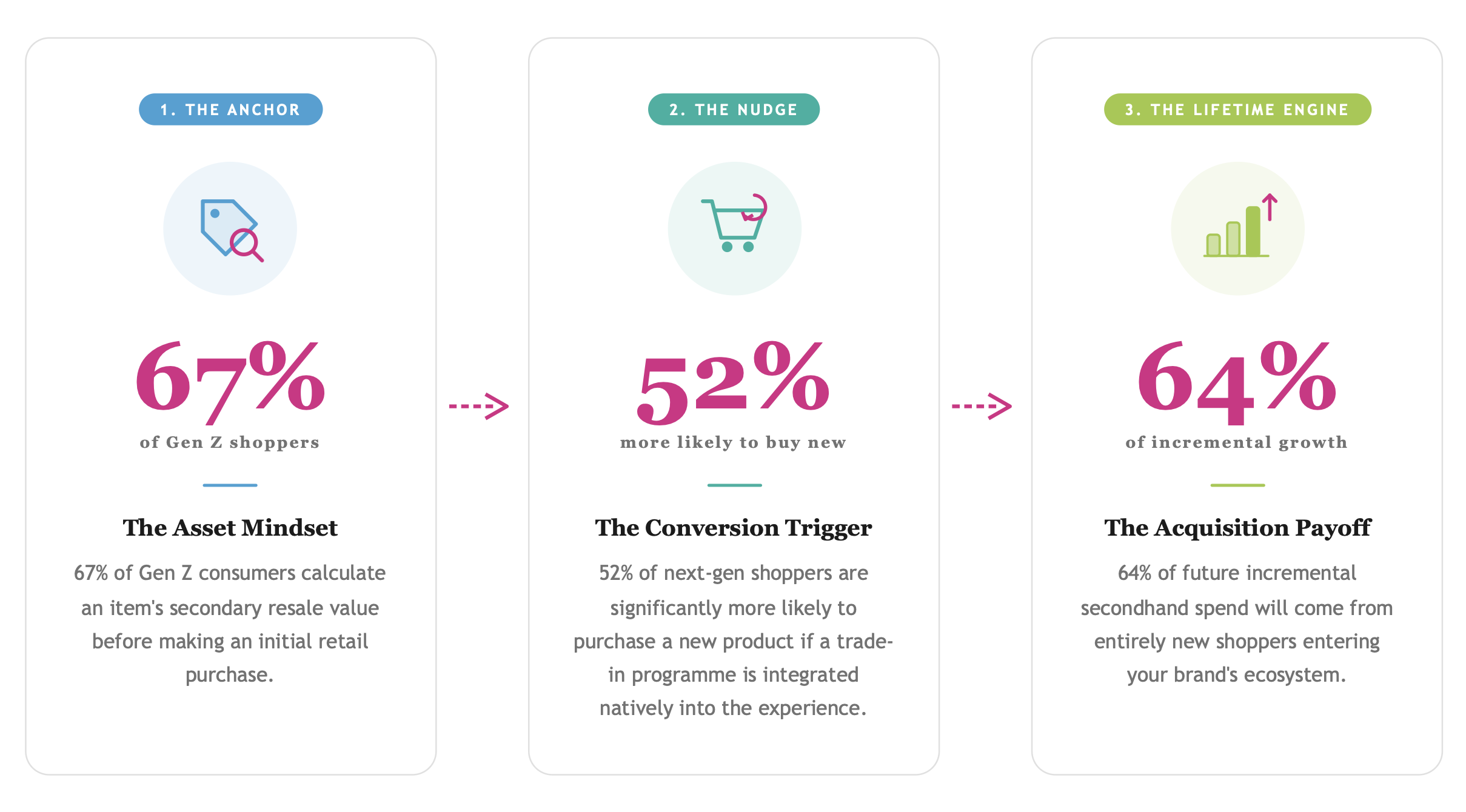
For Chief Marketing Officers and Chief Commercial Officers, this data reveals a goldmine for customer acquisition. Entirely new shoppers will account for a staggering 64% of incremental secondhand spend, with Gen Z driving 40% and Millennials driving 31% of that expansion.
Circular customer acquisition means using resale, trade-in, repair, rental, or buy-back offers to bring new customers into a brand’s ecosystem. Instead of treating the first sale as the end of the relationship, it treats every product lifecycle touchpoint as a chance to attract, convert, and keep a customer.
This matters because circular offers do more than reduce waste. They lower the barrier to first purchase, create reasons for customers to return, and help brands keep product value, customer data, and future spend inside their own ecosystem.
Why resale and trade-in now shape customer acquisition
Next-gen buyers do not view purchases as final, dead-end transactions; they see products as items with future value, whether that means resale, trade-in, repair, or reuse. The report reveals that 67% of Gen Z consumers consider the secondary resale value of a product before making an initial purchase, and 52% are significantly more likely to buy a brand-new item if a trade-in or circular program is natively integrated at checkout. Furthermore, 60% of younger shoppers report that visible, built-in circular features directly increase their overall trust in a brand.
Cross-sector market leaders are already restructuring their commercial capabilities to capture this highly profitable audience pull:
- Fashion & Apparel: E-commerce pioneer eBay has fundamentally repositioned its platform to capture the circular handoff, using advanced authentication systems to drive an explosion in high-value vintage apparel sales and next-gen customer acquisition.
- Household Goods: Global retail giant IKEA has successfully scaled its Buy Back & Resell initiative across 28 countries. By allowing customers to exchange used furniture for store credit, they recirculated over 686,500 items in a single year, transforming a potential waste stream into a powerful engine for repeat store traffic and customer loyalty.
- Electronics & Technology: Consumer tech leader Apple has deeply embedded trade-in and asset recovery frameworks directly into its global customer experience. By offering clear upfront credit for older hardware, they systematically lower the financial barrier for users upgrading to new devices, securing an incredibly high customer lifetime value.
To reinforce this trend, a comprehensive economic blueprint by the World Economic Forum estimates that moving toward circular commerce will unlock up to $4.5 trillion in global economic output by 2030 by transforming how brands retain material value. Concurrently, data from the Ellen MacArthur Foundation indicates that moving toward service-and use-based models is the single most effective strategy for brands to capture long-term customer preference.
Why circular demand stalls inside the business
Yet, despite this massive surge in market demand, a gaping execution block remains. The ThredUp 2026 Resale Report highlights a stark capability gap: 58% of retailers agree that lacking a circular presence creates a permanent structural disadvantage, but 52% admit they are not operationally equipped to rapidly scale under market pressure.
The breakdown is rarely a lack of consumer desire; it is a lack of systemic coordination. Organizations frequently attempt to launch circular initiatives as isolated, siloed marketing experiments. They fail to realise that an exceptional customer experience is impossible without completely aligning internal frontline incentives, external partner networks, and reverse-logistics channels. If your sales team is still compensated strictly on upfront unit volume, your circular offer will stall every single time.
💭 Circularity at scale is not an isolated pilot. True commercial success requires an integrated, ecosystem-wide approach that maps, targets, and activates every single stakeholder required to close the loop. 💭
Navigating this complexity requires moving past traditional go-to-market boundaries. To transition smoothly from a pilot to an established market presence, commercial leaders must align three operational levers: ensuring frontline incentives reward asset recovery rather than just product volume, integrating digital platforms with hyper-local reverse logistics, and designing an explicit commercial win for every external partner involved.
When these system pieces lock together, circularity stops being a downstream operational friction point and becomes a predictable engine for customer acquisition. For leadership teams looking for practical frameworks to audit their current commercial mix, map user journeys, and build a robust business case for the CFO, more structured guidance is available.
You can access the Circular Advantage Toolkit, developed in collaboration with the Exeter Centre for the Circular Economy, to help your teams begin mapping their transition today.