

The AI revolution is no longer theoretical. We are living it. AI is already reshaping how work gets done, how roles are defined, and how organizations think about productivity and cost. “Jobs to be done” are evolving, role titles are changing, and early evidence suggests a 33% - 45%1 reduction in entry-level job postings as AI increasingly performs tasks traditionally allocated to junior roles. Stepstone (a job platform covering Europe) also reported entry-level listings in Q1 2025 were 45% below the five-year average2.
Taken together, these shifts are fuelling understandable anxiety across the workforce. Concerns about job security are no longer isolated to specific generations, roles, or sectors. They are systemic. Against this backdrop, it is unsurprising that AI adoption is uneven, emotionally charged, and frequently contested.
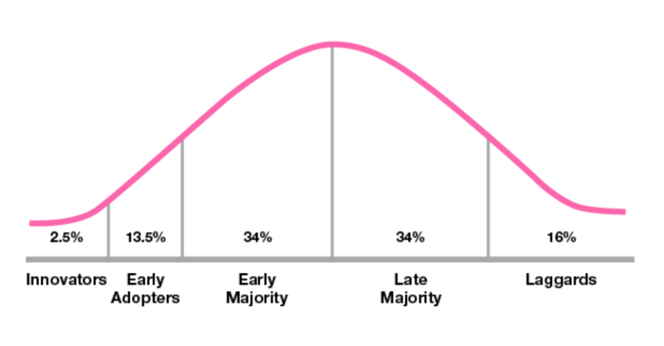
Change adoption curve: The five categories of AI adopters
LEARN MORE: AI isn't a tool, it's a teammate: A guide to team adaptation
Many employees are asking a reasonable question: Why should I adopt a technology that may ultimately eliminate or fundamentally change my role? We’ve been here before. PCs reshaped office work, spreadsheets replaced manual accounting tasks, and self-service analytics tools reduced the need for large reporting teams. Each wave of technology changed jobs rather than simply removing them - but not without uncertainty, disruption, and very real human cost. AI is no different, except in speed and scale.
This question sits in direct tension with the stance taken by many executives. Leaders across industries are doubling down on AI investment, often explicitly to reduce costs, improve efficiency, and increase margins. Gartner forecasts that worldwide AI spending will reach nearly $1.5 trillion in 2025, a massive leap from roughly $987 billion in 2024, driven largely by GenAI integration into core IT infrastructure3. The implication for the workforce is unavoidable. How do we balance the benefits of AI for society and enterprise which may contrast with the benefits of an individual?
In this article, I explore how leaders can credibly and responsibly engage with their workforce when AI adoption may lead to significant changes in how people work - and, in some cases, whether certain roles continue to exist at all.
Change is inevitable, but trust is not automatic
Change has always been a constant in business. What AI introduces is not just scale, but speed. The pace of change is accelerating, while the environment in which employees are expected to adapt is becoming more complex and less predictable.
It is important to acknowledge that no single approach will work indefinitely. Employee needs will continue to evolve, as will the technology itself. Leaders must therefore deploy multiple, reinforcing tactics rather than relying on one-off change initiatives or communications.
This brings us to the first, and arguably most important, recommendation.
1. Establish robust employee listening and two-way feedback on AI initiatives
Most organizations are not yet “AI-first.” In this transition period, employees remain the primary drivers of value creation. They are the ones who execute, adapt, and ultimately determine whether AI initiatives deliver meaningful returns.
But employees are not neutral delivery mechanisms. They are people. Their emotions, fears, and sense of security directly influence behavior, and therefore, business outcomes.
For this reason, organizations must invest in robust employee listening and two-way feedback mechanisms at both macro and micro levels. Leaders need visibility into:
- How AI initiatives are perceived at an enterprise level
- How AI is experienced in day-to-day work
- Where adoption is occurring willingly versus reluctantly
- Where fear, resistance, or disengagement is emerging.
Crucially, this insight must not remain buried in surveys or dashboards. It must be actively discussed in leadership forums and visibly shape decisions.
When employees feel heard, even when outcomes are difficult, they are more likely to rationalize change, accept trade-offs, and remain engaged. Consultation does not guarantee agreement, but it does build legitimacy.
Recommendations in short:
- Establish employee listening programmes at both macro (enterprise) and micro (team/workflow) levels
- Ensure leadership regularly reviews feedback and explicitly references it in decisions and communications
- Create a mixed-level AI employee forum to surface impacts across roles, functions, and seniority.
2. Honesty, transparency and communicating your AI vision to build trust
Vision statements are often underestimated - reduced to posters, slides, or email footers. In the context of AI-driven change, a clear and credible vision is essential.
Employees need to understand where the organization is heading and why. A well-articulated AI vision enables people to make informed decisions, both for the business and for themselves. This may include decisions to reskill, pivot roles, or, in some cases, leave the organization.
While uncomfortable, this clarity benefits everyone.
Honesty and transparency reduce speculation, mistrust, and the informal narratives that fill a vacuum when leadership communication is vague or overly optimistic. Over-selling AI or avoiding difficult truths creates more resistance, not less. Employees are adept at reading between the lines.
This does not mean leaders should be alarmist or deterministic. It does mean acknowledging uncertainty, trade-offs, and potential role impacts where they are likely.
Leaders should also actively engage with dissenting views. Open resistance is often a signal of fear, not obstruction. Engaging respectfully with those concerns, and repeatedly reinforcing the direction of travel, builds credibility even when consensus is impossible.
Recommendations in short:
- Clearly articulate your AI vision and strategic intent
- Communicate consistently, through appropriate channels, with a regular cadence
- Avoid over-promising or minimizing impact - clarity builds trust more effectively than reassurance.
3. Prioritize opportunity and upskilling: Building AI literacy in the workforce
By 2025, AI literacy is no longer optional. Employees are engaging with AI at home and at work, often through tools already embedded in everyday platforms such as Microsoft Copilot.
Yet many organizations still underinvest in AI capability development. Employees, the organization’s most valuable asset, are frequently expected to adapt without sufficient time, guidance, or support.
This represents a significant missed opportunity. Upskilling is not simply a retention tactic; it is a value creation strategy. Organizations that fail to invest here leave productivity, innovation, and engagement unrealzed.
Effective AI learning tends to emerge across three distinct areas.
-
Job-based skills and learning
Organizations must set direction. This includes defining baseline AI capabilities expected across roles and providing equitable access to foundational training.
This means:- Clear learning expectations
- Funded access to core training
- Dedicated time for learning
- Tracking completion and capability levels.
For employees already operating at advanced levels, organizations should actively leverage this expertise through learning communities, business challenges, and recognition mechanisms.
-
Peer-to-peer learning
Informal learning should not be underestimated. Peer learning remains critical, particularly for AI.
Employees are naturally sharing discoveries, shortcuts, and lessons learned. Leaders and managers should legitimize and encourage this behavior through knowledge-sharing sessions, open forums, and collaborative problem-solving.
Fear of being left behind is a powerful motivator. Organizations should address it proactively by creating safe, visible spaces for shared learning.
-
Self-guided learning
Employees understand their own workflows better than any central learning function. While organizations can prescribe certain training, they cannot predict what will most improve every individual’s day-to-day performance.
Providing time and funding for self-guided AI learning empowers employees to invest in what matters most to them and delivers disproportionate returns through intrinsic motivation.
-
Avoid total re-engineering, and respect tacit knowledge
No one fully understands how AI will ultimately reshape work. What is certain is that disruption will continue.
However, organizations should resist the temptation to re-engineer everything simply because AI makes it possible. The AI hype cycle will persist. Hallucinations will remain a risk. “AI slop” will continue to erode trust if left unchecked.
The organizations most likely to succeed are those with a strong grip on their value proposition, customer needs, and service quality. The people who best understand these realities are employees, holders of tacit knowledge about “how things really work around here.”
Wholesale reinvention risks alienating customers, diluting value propositions, and introducing changes that customers neither want nor trust.
Just because something can be augmented with AI does not mean it should be.
Organizations grounded in purpose and selective in where AI is applied retain strategic flexibility. They can switch models as technology evolves, or revert to analogue processes if trust falters or systems fail.
Recommendations in short:
- Work closely with employees to understand roles, processes, and genuine improvement opportunities
- Be ruthless in asking: Do we need AI here, or do we need to fix the root cause?
-
- Avoid over-centralizing on immature AI architectures that may become costly or obsolete.
Managing psychological safety and the fear of job loss
Fear of job loss is a rational response to rapid, structural change. AI accelerates this fear by intersecting directly with cost pressures and productivity expectations. However, the impact of AI on the future of work is inevitable, and leaders must be prepared to manage the employee experience where not everyone may win.
For some leaders, AI can seem like a convenient fix for systemic issues. But its success hinges on adoption by employees whose psychological safety may be eroded by job loss, redeployment, or uncertainty created by the AI rollout itself.
Leaders making workforce decisions should, therefore, exercise caution in positioning AI in line with a workforce reduction tool. Doing so risks eroding trust precisely where engagement and adoption are most needed.
Instead, successful organizations will guide their workforce through change with clarity, honesty, and investment. They will listen, communicate transparently, create real opportunities for learning, and remain grounded in how their business actually delivers value.
Employees are not a resource to be reshuffled without consequence. They are a strategic asset. Organizations that recognize this and act accordingly will be far better positioned to realize the promise of AI without sacrificing trust, performance, or long-term resilience.
Our AI consulting team can help leaders implement these core strategies and responsibly deploy AI while maintaining employee confidence. Get in touch to speak to an expert.
References
- The Guardian (2025) UK university graduates face toughest job market due to rise of AI. Available at: https://www.theguardian.com/money/2025/jun/25/uk-university-graduates-toughest-job-market-rise-of-ai
- The Stepstone Group (2025) Stepstone Analysis: Fewer Entry-Level Jobs, Longer Application Processes. Available at: https://www.thestepstonegroup.com/english/newsroom/press-releases/stepstone-analysis-fewer-entry-level-jobs-longer-application-processes/
- Gartner (2025) Gartner Says Worldwide AI Spending Will Total $1.5 Trillion in 2025. Available at: https://www.gartner.com/en/newsroom/press-releases/2025-09-17-gartner-says-worldwide-ai-spending-will-total-1-point-5-trillion-in-2025